

MNWAP – Production of indigenous chickens for household food security
November 27, 2024
EWADE Projects Fuel Economic Growth, Contribute Over E387 Million to Eswatini’s Tax Revenue in Five Years
November 27, 2024One of our strategic intents in the 2022-27 plan, is the pursuit of sustainable growth and water resource optimization in Eswatini, and one primary objective is to amplify the impact of small water development schemes across the nation. These schemes are not only essential for empowering rural communities but are also instrumental in building climate resilience and supporting sustainable agricultural practices.
By focusing on smaller, decentralized water solutions, we are committed to reaching remote areas and addressing water scarcity where it is needed most, ensuring that even the smallest farmer has access to reliable irrigation and water resources.
Through the Sustainable Market-Led Program (SMLP), we have made significant strides in community engagement, infrastructure development, and social empowerment – foundational pillars that reinforce our mission and impact. I am therefore filled with pride as we close one impactful chapter in our journey and embark on a new, ambitious path.
Over the past six years, the EWADE has supported communities across Eswatini through the Smallholder Market-Led Project (SMLP). Designed to transform smallholder farming from a subsistence activity into a profitable venture, the SMLP has reshaped Eswatini’s agricultural landscape, bringing hope and resilience to thousands. Now, as we transition to the Smallholder Agricultural Productivity Enhancement and Marketing Project (SAPEMP), we aim to drive even greater transformations, empowering Eswatini’s rural communities and enhancing food security.
Reflecting on SMLP’s Legacy
The journey with SMLP has been remarkable. This transformative project aimed to support poor, food-insecure smallholder farmers across Eswatini’s Lubombo, Manzini, and Shiselweni regions, enabling them to elevate their productivity and expand market participation.
Today, we look back at the significant strides achieved by the SMLP – many of which have exceeded expectations.
The SMLP reached over 71,000 beneficiaries, of whom 82 per cent were female-headed households. By creating market-driven opportunities, the SMLP didn’t just ensure that smallholders could feed their families; but it empowered them to produce surpluses, unlocking new income opportunities and raising living standards.
This market-led approach led to an 86 per cent success rate – an unprecedented milestone for Eswatini’s agricultural sector.
SMLP’s Key Successes
The SMLP was built around three pillars; community engagement, infrastructure development, and social empowerment, each foundational to the project’s impact. With a focus on collaboration, the EWADE worked hand-in-hand with local chiefdoms, empowering communities to participate in decision-making. This localized engagement created strong support systems that will continue to benefit smallholder farmers beyond the project’s lifespan.
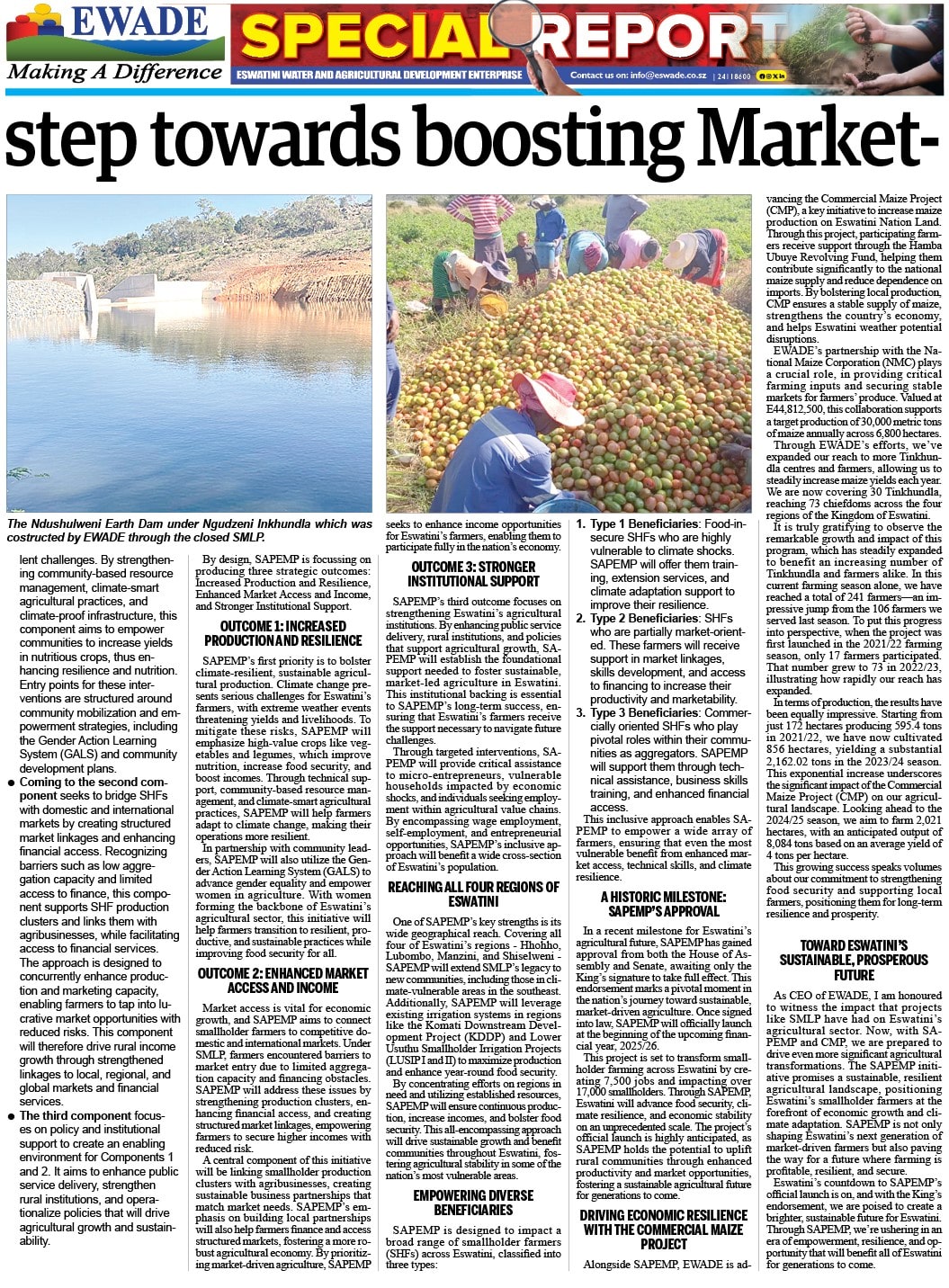
Another key achievement was infrastructure development. Through SMLP, the EWADE constructed nine earth dams which now irrigate over 94 hectares of farmland.
These dams provide essential water resources for market-led farming, especially in regions with scarce water access. Additionally, rooftop water harvesting systems were established in drought-prone areas, helping farmers secure reliable water for crop production.
The SMLP also formed structured market linkages in 37 chiefdoms, giving farmers the ability to produce surpluses and access local markets, boosting household income and food security.

Beyond market access and production, SMLP prioritized youth employment and women’s empowerment, particularly in value-added sectors like honey and horticulture. By engaging youth, SMLP helped cultivate a generation of agro-entrepreneurs, establishing a legacy that will continue shaping Eswatini’s agricultural industry for years to come.
SAPEMP: A New Dawn for Smallholders
As we transition from the SMLP, EWADE is ready to embark on an even more ambitious mission with SAPEMP. With a robust budget of E851,089,000 (US$45.5 million), funded by IFAD, GCF, the Government of Eswatini, and private sector contributors, SAPEMP reflects EWADE’s commitment to elevate Eswatini’s agricultural sector to new heights. Targeting 17,000 smallholder farmers across all four regions of Eswatini, SAPEMP aims to create 7,500 jobs and establish Eswatini as a regional leader in climate-smart, market-led agriculture.
Regarding its formation, SAPEMP is structured around three key components:
The first component of SAPEMP emphasizes climate-resilient, sustainable production to mitigate the impacts of climate change and extreme weather events, including droughts, floods, and heatwaves, that compromise crop yields and the participation of farmers in competitive markets. Limited technical support, uncoordinated production practices, and food insecurity are prevalent challenges. By strengthening community-based resource management, climate-smart agricultural practices, and climate-proof infrastructure, this component aims to empower communities to increase yields in nutritious crops, thus enhancing resilience and nutrition. Entry points for these interventions are structured around community mobilization and empowerment strategies, including the Gender Action Learning System (GALS) and community development plans.
Coming to the second component seeks to bridge SHFs with domestic and international markets by creating structured market linkages and enhancing financial access. Recognizing barriers such as low aggregation capacity and limited access to finance, this component supports SHF production clusters and links them with agribusinesses, while facilitating access to financial services. The approach is designed to concurrently enhance production and marketing capacity, enabling farmers to tap into lucrative market opportunities with reduced risks. This component will therefore drive rural income growth through strengthened linkages to local, regional, and global markets and financial services.
The third component focuses on policy and institutional support to create an enabling environment for Components 1 and 2. It aims to enhance public service delivery, strengthen rural institutions, and operationalize policies that will drive agricultural growth and sustainability.
By design, SAPEMP is focussing on producing three strategic outcomes: Increased Production and Resilience, Enhanced Market Access and Income, and Stronger Institutional Support.
Outcome 1: Increased Production and Resilience
SAPEMP’s first priority is to bolster climate-resilient, sustainable agricultural production. Climate change presents serious challenges for Eswatini’s farmers, with extreme weather events threatening yields and livelihoods. To mitigate these risks, SAPEMP will emphasize high-value crops like vegetables and legumes, which improve nutrition, increase food security, and boost incomes. Through technical support, community-based resource management, and climate-smart agricultural practices, SAPEMP will help farmers adapt to climate change, making their operations more resilient.
In partnership with community leaders, SAPEMP will also utilize the Gender Action Learning System (GALS) to advance gender equality and empower women in agriculture. With women forming the backbone of Eswatini’s agricultural sector, this initiative will help farmers transition to resilient, productive, and sustainable practices while improving food security for all.
Outcome 2: Enhanced Market Access and Income
Market access is vital for economic growth, and SAPEMP aims to connect smallholder farmers to competitive domestic and international markets. Under SMLP, farmers encountered barriers to market entry due to limited aggregation capacity and financing obstacles. SAPEMP will address these issues by strengthening production clusters, enhancing financial access, and creating structured market linkages, empowering farmers to secure higher incomes with reduced risk.
A central component of this initiative will be linking smallholder production clusters with agribusinesses, creating sustainable business partnerships that match market needs. SAPEMP’s emphasis on building local partnerships will also help farmers finance and access structured markets, fostering a more robust agricultural economy. By prioritizing market-driven agriculture, SAPEMP seeks to enhance income opportunities for Eswatini’s farmers, enabling them to participate fully in the nation’s economy.
Outcome 3: Stronger Institutional Support
SAPEMP’s third outcome focuses on strengthening Eswatini’s agricultural institutions. By enhancing public service delivery, rural institutions, and policies that support agricultural growth, SAPEMP will establish the foundational support needed to foster sustainable, market-led agriculture in Eswatini. This institutional backing is essential to SAPEMP’s long-term success, ensuring that Eswatini’s farmers receive the support necessary to navigate future challenges.
Through targeted interventions, SAPEMP will provide critical assistance to micro-entrepreneurs, vulnerable households impacted by economic shocks, and individuals seeking employment within agricultural value chains. By encompassing wage employment, self-employment, and entrepreneurial opportunities, SAPEMP’s inclusive approach will benefit a wide cross-section of Eswatini’s population.
Reaching All Four Regions of Eswatini
One of SAPEMP’s key strengths is its wide geographical reach. Covering all four of Eswatini’s regions – Hhohho, Lubombo, Manzini, and Shiselweni – SAPEMP will extend SMLP’s legacy to new communities, including those in climate-vulnerable areas in the southeast. Additionally, SAPEMP will leverage existing irrigation systems in regions like the Komati Downstream Development Project (KDDP) and Lower Usuthu Smallholder Irrigation Projects (LUSIP I and II) to maximize production and enhance year-round food security.
By concentrating efforts on regions in need and utilizing established resources, SAPEMP will ensure continuous production, increase incomes, and bolster food security. This all-encompassing approach will drive sustainable growth and benefit communities throughout Eswatini, fostering agricultural stability in some of the nation’s most vulnerable areas.
Empowering Diverse Beneficiaries
SAPEMP is designed to impact a broad range of smallholder farmers (SHFs) across Eswatini, classified into three types:
- Type 1 Beneficiaries: Food-insecure SHFs who are highly vulnerable to climate shocks. SAPEMP will offer them training, extension services, and climate adaptation support to improve their resilience.
- Type 2 Beneficiaries: SHFs who are partially market-oriented. These farmers will receive support in market linkages, skills development, and access to financing to increase their productivity and marketability.
- Type 3 Beneficiaries: Commercially oriented SHFs who play pivotal roles within their communities as aggregators. SAPEMP will support them through technical assistance, business skills training, and enhanced financial access.
This inclusive approach enables SAPEMP to empower a wide array of farmers, ensuring that even the most vulnerable benefit from enhanced market access, technical skills, and climate resilience.
A Historic Milestone: SAPEMP’s approval
In a recent milestone for Eswatini’s agricultural future, SAPEMP has gained approval from both the House of Assembly and Senate, awaiting only the King’s signature to take full effect. This endorsement marks a pivotal moment in the nation’s journey toward sustainable, market-driven agriculture. Once signed into law, SAPEMP will officially launch at the beginning of the upcoming financial year, 2025/26.
This project is set to transform smallholder farming across Eswatini by creating 7,500 jobs and impacting over 17,000 smallholders. Through SAPEMP, Eswatini will advance food security, climate resilience, and economic stability on an unprecedented scale. The project’s official launch is highly anticipated, as SAPEMP holds the potential to uplift rural communities through enhanced productivity and market opportunities, fostering a sustainable agricultural future for generations to come.
Driving Economic Resilience with the Commercial Maize Project
Alongside SAPEMP, EWADE is advancing the Commercial Maize Project (CMP), a key initiative to increase maize production on Eswatini Nation Land. Through this project, participating farmers receive support through the Hamba Ubuye Revolving Fund, helping them contribute significantly to the national maize supply and reduce dependence on imports. By bolstering local production, CMP ensures a stable supply of maize, strengthens the country’s economy, and helps Eswatini weather potential disruptions.
EWADE’s partnership with the National Maize Corporation (NMC) plays a crucial role, in providing critical farming inputs and securing stable markets for farmers’ produce. Valued at E44,812,500, this collaboration supports a target production of 30,000 metric tons of maize annually across 6,800 hectares.
Through EWADE’s efforts, we’ve expanded our reach to more Tinkhundla centres and farmers, allowing us to steadily increase maize yields each year. We are now covering 30 Tinkhundla, reaching 73 chiefdoms across the four regions of the Kingdom of Eswatini.
It is truly gratifying to observe the remarkable growth and impact of this program, which has steadily expanded to benefit an increasing number of Tinkhundla and farmers alike. In this current farming season alone, we have reached a total of 241 farmers—an impressive jump from the 106 farmers we served last season. To put this progress into perspective, when the project was first launched in the 2021/22 farming season, only 17 farmers participated. That number grew to 73 in 2022/23, illustrating how rapidly our reach has expanded.
In terms of production, the results have been equally impressive. Starting from just 172 hectares producing 595.4 tons in 2021/22, we have now cultivated 856 hectares, yielding a substantial 2,162.02 tons in the 2023/24 season. This exponential increase underscores the significant impact of the Commercial Maize Project (CMP) on our agricultural landscape. Looking ahead to the 2024/25 season, we aim to farm 2,021 hectares, with an anticipated output of 8,084 tons based on an average yield of 4 tons per hectare.
This growing success speaks volumes about our commitment to strengthening food security and supporting local farmers, positioning them for long-term resilience and prosperity.
Toward Eswatini’s Sustainable, Prosperous Future
As CEO of EWADE, I am honoured to witness the impact that projects like SMLP have had on Eswatini’s agricultural sector. Now, with SAPEMP and CMP, we are prepared to drive even more significant agricultural transformations. The SAPEMP initiative promises a sustainable, resilient agricultural landscape, positioning Eswatini’s smallholder farmers at the forefront of economic growth and climate adaptation. SAPEMP is not only shaping Eswatini’s next generation of market-driven farmers but also paving the way for a future where farming is profitable, resilient, and secure.
Eswatini’s countdown to SAPEMP’s official launch is on, and with the King’s endorsement, we are poised to create a brighter, sustainable future for Eswatini. Through SAPEMP, we’re ushering in an era of empowerment, resilience, and opportunity that will benefit all of Eswatini for generations to come.


